Public advisory: Malaysia's cyber threat level is now Medium. What it means for you, and what anyone in IT must do now
What happened
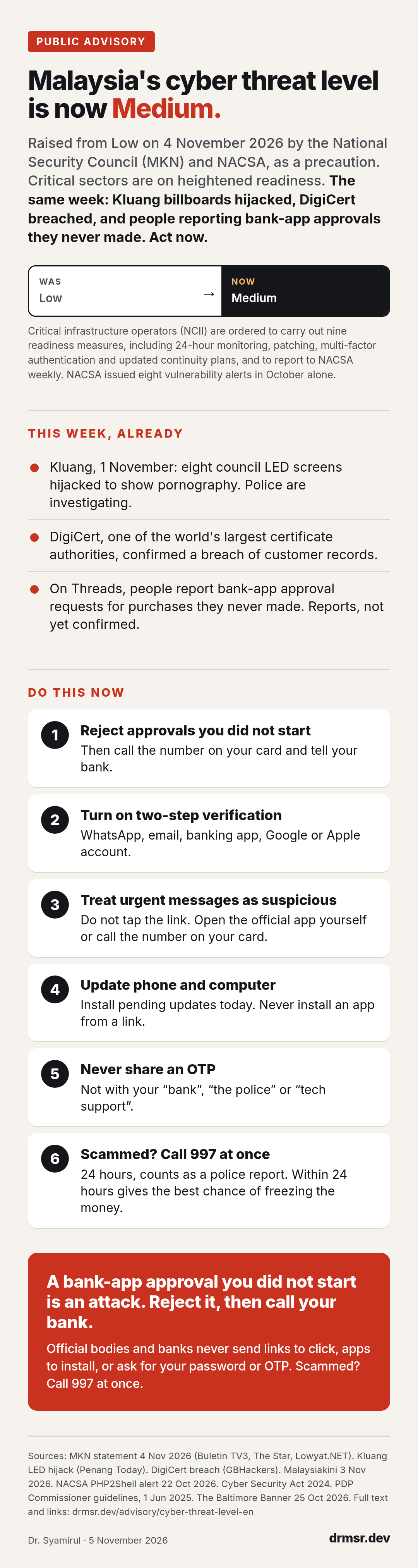
On 4 November 2026 the National Security Council (Majlis Keselamatan Negara, MKN) announced that the National Cyber Security Agency (NACSA) has raised the National Cyber Security Threat Level from Low to Medium. MKN called it a precaution in light of current security developments, meant to keep essential services running.
It followed the Prime Minister's statement in the Dewan Rakyat on 3 November, after a special MKN meeting the day before. He said Malaysia is considered a potential target for cyberattacks, for two reasons: the country's digital infrastructure and data centres are among the strongest in the region, and its position on Palestine. He added that not everything the government knows can be made public.
Organisations that run the country's critical systems (the National Critical Information Infrastructure, or NCII) have been ordered to carry out nine readiness measures. The four made public are round-the-clock security monitoring, patching of systems, multi-factor authentication, and updated service continuity plans. Sector heads must now report their threat status to NACSA every week. In October alone, NACSA's coordination centre (NC4) issued eight alerts about vulnerabilities affecting critical operators and government agencies.
What this means for you
This is not a drill, and it is already touching ordinary people. In the same week the level was raised:
- Kluang, 1 November. Eight Kluang Municipal Council LED screens around the town were hijacked to show pornographic videos. A group calling itself "Leakers" claimed it, said it wanted to expose weak security, and claimed the same sweep hit screens in Egypt, Iraq, Brazil and China. Police have opened investigations. (report)
- DigiCert. One of the world's largest certificate authorities confirmed that an internal system holding archived customer records was accessed without authorisation, exposing business contact details and, for some accounts, identity documents. DigiCert says certificate issuance was not affected. (report)
- Banking app prompts. On Threads, people are reporting approval requests appearing in their banking app for purchases they never made. These are user reports, not a confirmed incident, but they are exactly what an account takeover attempt looks like.
The government calls the higher level a precaution. Read alongside this week, it is a warning to act now. Official bodies and banks never send you links to click, apps to install, or ask for your password or one-time code.
What to do now
- If your banking app asks you to approve something you did not start, reject it. Then call the number printed on your card and tell your bank. Do not approve "to see what happens".
- Turn on two-step verification. WhatsApp (Settings, Account, Two-step verification), your email, your banking app, your Google or Apple account. This one setting stops most account takeovers.
- Treat urgent messages as suspicious, especially any that mention this alert, your bank, the government, or an "update". Do not tap the link. Open the official app yourself.
- Update your phone and your computer, and never install an app from a link. Install pending system and app updates today. If you received a ZIP file through WhatsApp recently, read our earlier advisory.
- Never give anyone your one-time code (OTP), and back up what matters. Not your "bank", not "the police", not "tech support". Keep one copy of your photos and files somewhere that is not the same device.
- If you are scammed, call 997 at once. The National Scam Response Centre runs 24 hours a day and the call counts as a police report. Reporting within 24 hours gives the best chance of freezing the money.
References
- Majlis Keselamatan Negara statement, 4 November 2026, reported by Buletin TV3, The Star and Lowyat.NET
- Malaysiakini, 3 November 2026, M'sia a potential target for security threats amid global volatility, PM says
- NACSA alert on PHP2Shell, 22 October 2026, reported by Lowyat.NET; advisories at nacsa.gov.my
- Cyber Security Act 2024 (Act 854), summary by CMS and ASEAN Briefing
- Personal Data Protection Commissioner guidelines on data breach notification and Data Protection Officers, in force 1 June 2025, summary by DLA Piper
- Johns Hopkins Bayview exposure: The Baltimore Banner, 25 October 2026, and Inc.
- National Scam Response Centre 997, malaysia.gov.my